
SMD LED
The light source documented on the LED luminous membrane switch page. Ask how many LEDs sit behind each key, how the diffuser spreads light across a wide icon, and how bleed between neighbouring keys is controlled.
Choosing an illuminated membrane switch manufacturer is a qualification exercise, not a catalogue browse: the panel you approve has to survive sealing checks, press-life targets and a full production run. This guide sets out the criteria worth scoring, the evidence to request before tooling is released, and the product facts that turn a custom membrane switch requirement into a brief a supplier can quote against.
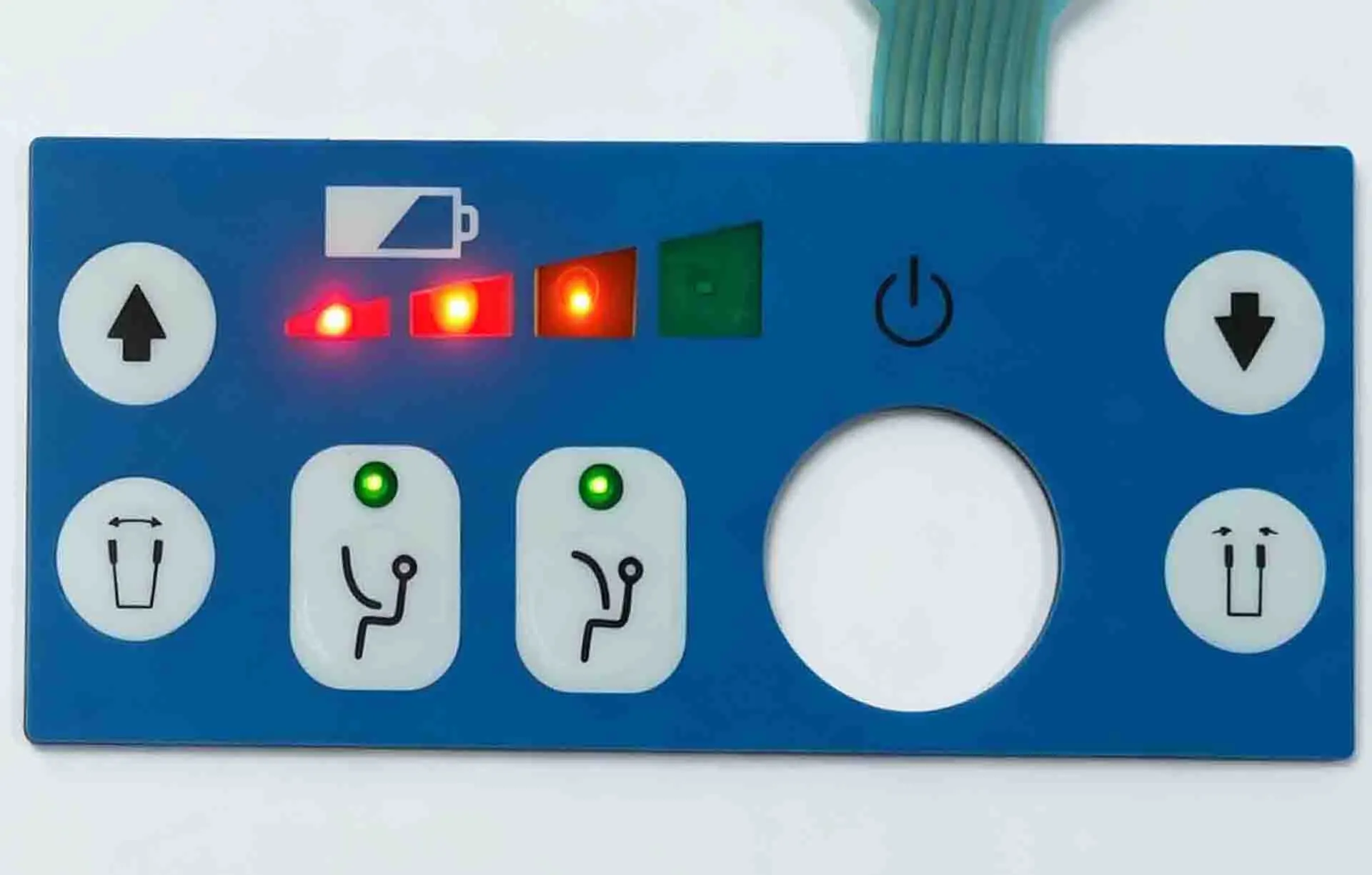
Score every shortlisted vendor on the same eight criteria and weight them for a backlit panel programme. The percentages below are a starting point — shift them if sealing or documentation carries more risk for your product.
| Criterion | Weight | What good looks like | Evidence to ask for |
|---|---|---|---|
| Engineering responsiveness | 20% | Written design feedback on your drawing before a price is issued, with questions about layer stack, LED placement and connector orientation rather than a generic quotation. | A red-lined drawing or design note, a named engineer to contact, and a response time on one follow-up question. |
| Sealing and ingress verification | 18% | A sealing claim tied to a test method and an acceptance criterion — not just the word “waterproof” on a datasheet. | Sample report recording the sealing check performed, with your target level restated in writing. |
| Backlight capability breadth | 15% | Working experience with the light source your design needs, plus a clear opinion on evenness and light bleed between adjacent keys. | Photographs of comparable lit panels, the diffuser approach, and a colour and intensity proposal. |
| Tactile and material options | 12% | Both metal and polyester spring options offered, with a recommendation matched to how the operator should feel the key. | A sample set showing both spring types and the overlay materials proposed for your finish. |
| Documentation and traceability | 13% | Revision control on artwork and film layers, and lot traceability on delivered parts. | Sample report, a revision block on the drawing, and the packaging specification. |
| Tooling and artwork ownership | 10% | Your artwork and tooling files remain yours and can be transferred if the project moves. | A written statement on file ownership and the transfer terms in the contract. |
| Communication and change control | 7% | One contact who owns the project and a documented route for engineering changes after approval. | A change-control note and an escalation contact above the day-to-day contact. |
| Commercial clarity | 5% | A quote broken down by layer, tooling and volume tier, so you can see what drives the price. | An itemised quotation, packaging cost line and a price-break schedule by volume. |
Four light sources turn up in backlit panels. Breadth is a tie-breaker rather than a ranking — match the technology to your panel, then check the supplier has actually built it.
The light source documented on the LED luminous membrane switch page. Ask how many LEDs sit behind each key, how the diffuser spreads light across a wide icon, and how bleed between neighbouring keys is controlled.
A flat, even light source. Ask whether the supplier laminates the electroluminescent sheet in-house or buys it in, and how brightness change over the panel’s service life is handled in the design.
Ask for the light-guide pattern design and how evenness is measured across a large overlay, since long panels are where uneven illumination usually shows up first.
Ask how the fibre is routed to each key, how it is terminated at the light source, and what happens to the bundle when the overlay is bent during assembly.
A supplier who offers only one technology is not automatically weaker — but a supplier who claims all four should be able to show a built sample of each before you rely on the claim in your scoring.
The product figures below are the ones stated on the LED luminous membrane switch product page. Use them as the factual anchor when you compare quotes — and confirm anything the page does not state, such as electrical ratings, in writing for your own build.
| Item | Stated value |
|---|---|
| Product name | LED luminous membrane switch |
| Overall thickness | Can be made very thin — usually under 1 mm |
| Press life | Typically withstands over a million presses |
| Sealing | Completely sealed construction: waterproof, dustproof, oil-proof, chemical-corrosion resistant |
| Sealing rating | IP65+ appears in the product page metadata — confirm the level against your own test specification |
| Light source | Embedded SMD LEDs (stated in the page metadata) |
| Tactile options | Metal springs for a clear click, or polyester springs for a soft, gentle linear feel |
| Integration | Buttons, LED indicators, resistors and capacitors combined on a single thin film |
| Surface | Smooth, easy-to-clean overlay; patterns, colours and lighting effects can be designed |
Product page note: the body copy describes a completely sealed construction, while the IP65+ rating and the SMD LED detail are stated in the page metadata. Put the exact ingress level and light source in your RFQ so the quotation is written against your requirement, not a general description.
Most backlit panel projects fall into one of six situations. Each one pushes a different requirement to the front of the brief — get that requirement into the drawing and the comparison between suppliers becomes much simpler.
Five stages from drawing to golden sample. At each stage the wording is the same: request evidence of the thing you are being asked to trust.
Send the drawing and the overlay artwork together. Ask for written design feedback on layer stack, LED placement, spring selection and connector orientation.
Agree the overlay, upper and lower circuit layers with their contact points, the spacer and the adhesive. Every material proposed should be named in the sample report.
Ask for a sample built to the same stack that will go into production, with a report recording measured overall thickness and the tactile feel of each key.
Request documentation of the press-life and sealing checks the supplier runs on comparable builds, together with the acceptance criteria used to pass them.
Sign and retain the approved sample, fix the artwork revision, and agree the packaging and labelling specification before the production run starts.
Six elements decide whether a backlit panel quotation is comparable. State each one, even if your answer is “propose something” — that still gives the supplier a fixed point to respond to.
Brief: four keys, one indicator LED per key, total stack target under 1 mm, washdown duty, annual volume stated.
What the product page already supports: a build that can be made usually under 1 mm, over a million presses, a completely sealed construction, embedded SMD LED indicators, and a choice of metal or polyester springs for the click.
What you add: the ingress level you will test to, the LED colour, the connector pinout, and the packaging specification.
Send This Brief for a QuoteA complete request shortens the design loop and makes the returned quotations genuinely comparable. Attach all eight items where you have them.
PDF plus a vector or CAD file if you have one, with a revision block and the panel outline dimensioned.
Print-ready file with icons, legends, colour references and the areas that must illuminate.
Your intended construction, or an explicit request for the supplier to propose one for review.
Colour, which keys or icons light, and whether the indicator is always on or status-triggered.
Type, pin count, orientation and the mating harness that will meet it on your board.
The level you will test to, stated numerically so the quotation is written against it.
Annual volume, first order quantity and expected product lifetime, so price breaks are meaningful.
Bagging or tray format, box marking and any incoming inspection you will run on receipt.
What should come back: a written design note, an itemised quotation, a sample lead time, and the format of the sample report you will receive before approval.
Any of these on its own is a question to ask. Three together is a reason to keep the shortlist open a little longer.
Send your drawing, artwork and ingress target for written design feedback before a quotation is issued. If the panel is still at concept stage, send what you have and ask for a proposed layer stack.
Keep adjacent product options together for a faster catalog comparison.

A custom membrane switch panel for tactile HMI control.
View product
Epoxy membrane switch with raised 3D crystal keycaps, a sealed 0.5–2 mm profile and adjustable tactile feel for medical and industrial HMI panels.
View product
ESD shielded membrane switches use a conductive shield layer and grounding traces to protect sensitive electronics from static discharge.
View productas a qualification exercise. the page scores responsiveness at 20 percent and sealing and ingress verification at 18 percent, with the remaining weight spread across the other criteria a buyer has to evidence.
written design feedback on your drawing before a price is issued, with questions about layer stack, LED placement and connector orientation rather than a generic quotation, plus a named engineer and a stated response time.
a sealing claim tied to a test method and an acceptance criterion, plus a sample report recording the sealing check performed. the word waterproof on a datasheet on its own is not treated as evidence.
the layer stack, the LED positions and the connector orientation, since those are the three points the page expects a supplier to question before pricing.
because the panel you approve has to survive sealing checks in production, and those checks are performed on the built part rather than on the datasheet.
the drawing, the operating environment the panel will sit in, the sealing requirement and the expected volume, so the response can be a design review rather than a catalogue reply.
