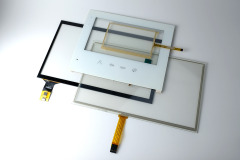
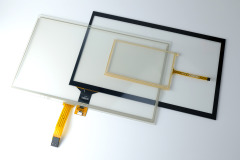
Pressure Sensing It consists of two conductive thin films (usually ITO indium tin oxide) separated by tiny gaps. When a finger or stylus presses down, the two films come into contact, and the touch location is determined by detecting changes in voltage.
Physical pressure required It requires a certain amount of pressure to trigger.
advantage :
Low cost, suitable for low-cost equipment.
It can be operated with any object (finger, glove, stylus).
Resistant to surface stains and water damage.
electric field induction This technology utilizes the electrical current sensing of the human body. The screen surface is coated with a conductive material; when a finger touches it, it changes the local electric field, allowing for precise positioning via sensors (such as self-capacitance or mutual capacitance).
No pressure A simple touch is all it takes to respond.
advantage :
High sensitivity, supports multi-touch (mainstream supports more than 10 points).
High light transmittance for clearer display. High durability (scratch-resistant glass surface).